- SCO 214, VIP Central, VIP Road, Zirakpur
- +91 9711153521 : +91 9467948024
- 9AM - 8 PM

Plot Cancelled During a Property Dispute and Sold to Someone Else — What Did the RERA Tribunal Do?
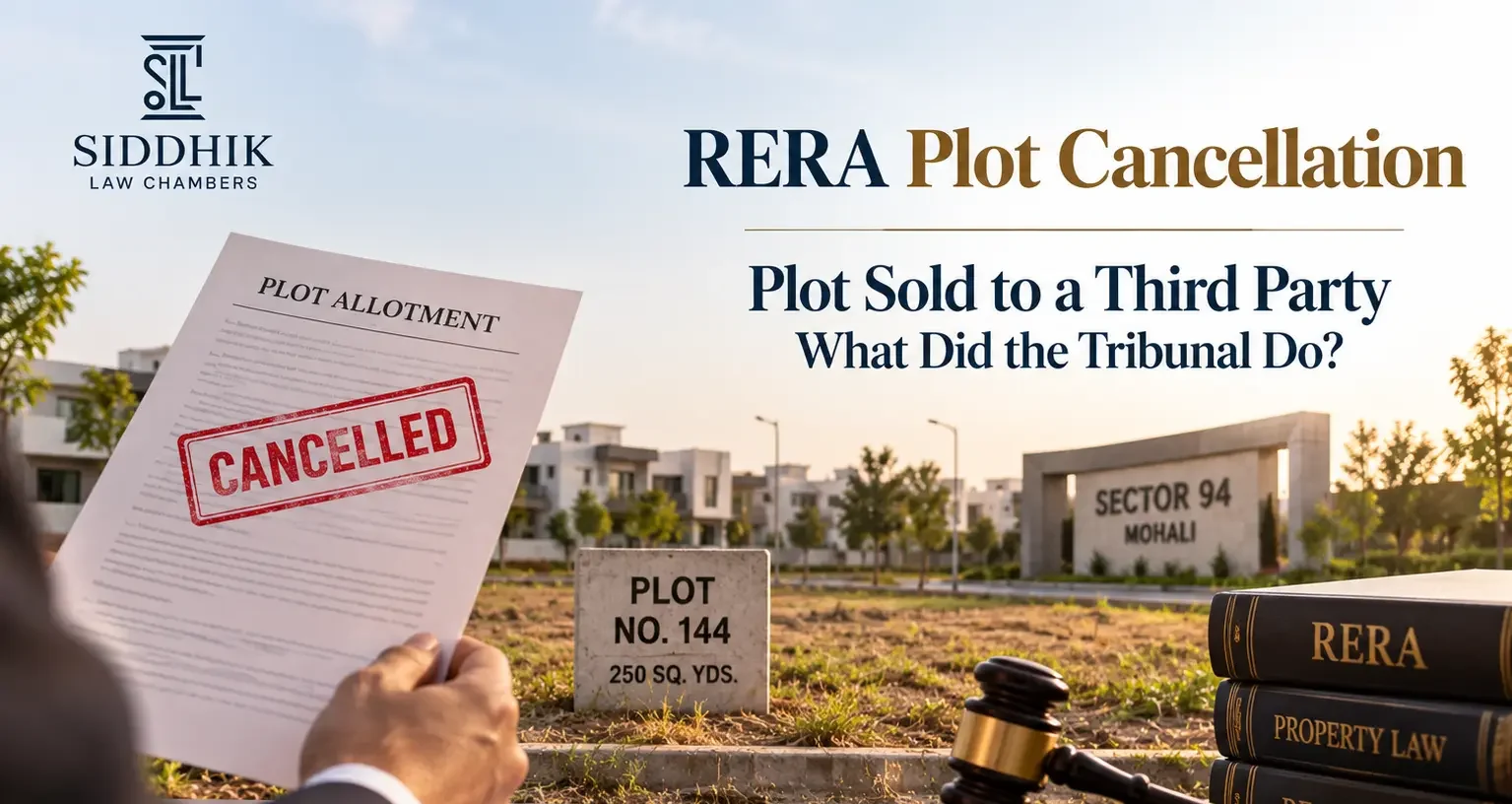
Plot Cancelled During a Property Dispute and Sold to Someone Else — What Did the RERA Tribunal Do?
Imagine booking a residential plot and paying money towards it, only to wait for years before receiving an allotment.
Then, when a plot is finally offered, it is larger than what you originally wanted and comes with an additional financial burden. You dispute the demand. While that dispute is still pending, the allotment is cancelled and the plot is sold to someone else.
A matter before the Real Estate Appellate Tribunal, Punjab at Chandigarh dealt with circumstances of this nature.
The dispute went back to 2005 and involved a residential plot in Mohali. Advocate Shubham Aggarwal and Advocate Suksham Aggarwal appeared for the appellant along with Senior Advocate Pawan Antuja.
A 200 Sq. Yard Plot Was Originally Booked
The order records that a 200 sq. yd. plot was booked in 2005, at a time when the project had yet to be formalised.The agreed rate was ₹11,500 per sq. yd.
For approximately seven years, however, no allotment took place. In 2012, an allotment letter was issued. But instead of the originally contemplated 200 sq. yd. plot, Plot No. 144 measuring 250 sq. yds. was allotted.
That additional 50 sq. yds. also came at a considerably higher rate. While the original rate was ₹11,500 per sq. yd., the additional area was initially priced at: ₹27,000 per sq. yd.
Why Did the Buyer Dispute the Additional 50 Sq. Yards?
This became an important part of the case. The order records that the additional 50 sq. yds. had never been sought by the allottee.
The Tribunal’s differing opinion observed that giving this additional area to an unwilling buyer and demanding a higher price for it was “highly arbitrary.”
It also noted that accepting money from a prospective allottee when there was no concretised launch of a project would be in violation of the provisions of the PAPRA Act. This point matters because the subsequent payment dispute could not be viewed without considering why the allottee had objected to the demand in the first place.
₹6.20 Lakh Remained With the Developer
The order records another important figure: ₹6,20,000 This amount had already been paid.The Tribunal observed that the respondent had retained ₹6.20 lakh for more than seven years without offering any tangible benefit to the allottee, and had subsequently offered a plot of a larger dimension with an additional cost.
The allottee continued to dispute the additional area and the price being demanded for it.
What Changed on 18 September 2020?
A major development took place on 18 September 2020. The respondent agreed to reduce the price of the additional 50 sq. yds. from ₹27,000 per sq. yd. to the original rate of: ₹11,500 per sq. yd.
This effectively applied a uniform rate of ₹11,500 per sq. yd. to the entire 250 sq. yd. plot. After rescheduling, the total sale consideration was recorded as: ₹28,75,000
Out of this, ₹6,20,000 had already been paid, leaving a balance of ₹22,55,000 payable in instalments. The order records that no further amount was subsequently paid towards the sale price in terms of the allotment.
The Tribunal treated 18 September 2020 as an important point for determining the respective rights and liabilities of the parties.
The Complaint Was Filed — Then the Plot Was Cancelled
The allottee approached the appropriate forum with a grievance concerning delayed possession. But something important happened while the dispute was pending.
The respondent cancelled the allotment. The plot was then alienated in favour of another person. The Tribunal took serious note of this sequence of events. It observed that when parties are already “at lis”, developments occurring during the pendency of the dispute can be considered by the Court or Tribunal. The order further stated that nothing prevents restoration of the parties to the status quo ante.
It consequently found that the cancellation needed to be set aside and the parties restored to the position existing when the complaint was filed.
What Did the RERA Appellate Tribunal Direct?
Since the original Plot No. 144 had already been sold to a third party, simply restoring that particular plot was no longer straightforward. The order therefore provided a practical remedy.
The respondent was directed to immediately offer a 250 sq. yd. plot in its Mega Residential Project, Sector 94, Mohali.
The replacement plot was to be offered: within three months from the date of the order.
The allottee, in turn, was required to take possession after making the payment calculated at ₹11,500 per sq. yd., along with interest at the rate prescribed under the Act read with Rule 16 of the Rules, commencing from 18 September 2020.
What Happened to the ₹6.20 Lakh Paid in 2005?
The Tribunal separately dealt with the money that had remained with the respondent for many years. It directed that the ₹6.20 lakh retained since 2005 was to be adjusted towards the price of the 250 sq. yd. plot along with interest.
For the period during which the amount had remained with the respondent before 2020, the order applied: 7.5% interest
The reasoning was significant. The RERA Act came into existence in 2016, whereas the money had been retained from 2005. The Tribunal therefore observed that it could not bind the respondent to a statutory interest rate under RERA for the earlier period. For that reason, 7.5% interest was applied to the ₹6.20 lakh retained from 2005 to 2020.
What About Interest for Delayed Possession?
The order also addressed delayed possession separately.It held the respondent liable to pay the statutory rate of interest for delayed possession from 18 September 2020 until possession was actually handed over.
This distinction is important. The order did not simply apply one interest rate across the entire period beginning in 2005. Instead, it treated the earlier retention of ₹6.20 lakh and the later period of delayed possession differently.
Why This RERA Plot Cancellation Case Matters
This dispute is useful for property buyers because it shows how complicated an allotment can become when several events happen over a long period. The buyer originally sought a 200 sq. yd. plot.
A 250 sq. yd. plot was subsequently allotted. The additional 50 sq. yds. was initially demanded at ₹27,000 per sq. yd.
Years later, that rate was reduced to ₹11,500 per sq. yd. The buyer’s money had remained with the developer since 2005.
Then, while the dispute concerning delayed possession was pending, the allotment was cancelled and the plot was sold to a third party. The Tribunal did not examine the cancellation in isolation. It considered the history of the transaction and the developments that occurred while the parties were already in litigation.
For buyers dealing with RERA plot cancellation, delayed possession or property allotment disputes in Mohali and other parts of Punjab, this demonstrates why the complete chronology of a transaction can matter as much as the final cancellation letter. Booking documents, payment receipts, allotment letters, demands raised by the developer, revised offers, correspondence and documents relating to cancellation can all become relevant when the dispute reaches RERA or the RERA Appellate Tribunal.
A Practical Point for Property Buyers
One particularly useful aspect of this case is that the allotted plot had already been transferred to a third party. That did not bring the dispute to an end.
Instead, the order fashioned relief around the circumstances that then existed by directing the respondent to offer another 250 sq. yd. plot in Sector 94, Mohali. It demonstrates why the remedy in a property dispute may depend upon what has happened to the property during the litigation itself.
Frequently Asked Questions
Can a developer cancel a plot while a RERA dispute is pending?
The answer depends on the facts and circumstances of the individual matter. In this case, the Tribunal considered the cancellation that occurred while the parties were already in litigation and found that the cancellation needed to be set aside.
What happens if an allotted plot is sold to a third party?
The available remedy depends upon the facts and the relief that can practically be granted. Here, because the earlier plot stood sold to a third party, the respondent was directed to offer another 250 sq. yd. plot in its Sector 94, Mohali project within three months.
Can a developer increase the plot size and charge a higher rate?
The answer depends upon the agreement and facts of the transaction. In this case, the Tribunal noted that the additional 50 sq. yds. had not been sought by the allottee and described imposing the additional area at a higher price on an unwilling buyer as highly arbitrary.
Can interest be claimed for delayed possession under RERA?
Depending upon the facts and applicable provisions, interest may be payable for delayed possession. In this order, statutory interest for delayed possession was directed from 18 September 2020 until possession was handed over.
Recent Post
-
 Can Police Arrest You Without Prior Notice? Court Directs 5 Days’ Notice Before Arrest
 -
 New Offences Added After Anticipatory Bail — Can Police Arrest You Again?
 -
 Electricity Department Negligence: Family Awarded ₹8.80 Lakh Compensation in Ambala
 -
 Plot Cancelled During a Property Dispute and Sold to Someone Else — What Did the RERA Tribunal Do?
 -
 Parties Reached a Compromise, But What Happens to the FIR?
At Siddhik Law Chambers, matters involving RERA plot cancellation, delayed possession, property allotment disputes, builder-buyer disputes and proceedings before Punjab RERA and the Real Estate Appellate Tribunal at Chandigarh are examined on the basis of the transaction documents, payment history and applicable legal framework.
Need Legal Clarity?
For general information or appointment requests, feel free to contact Siddhik Law Chambers.