- SCO 214, VIP Central, VIP Road, Zirakpur
- +91 9711153521 : +91 9467948024
- 9AM - 8 PM

Electricity Department Negligence: Family Awarded ₹8.80 Lakh Negligence Compensation in Ambala
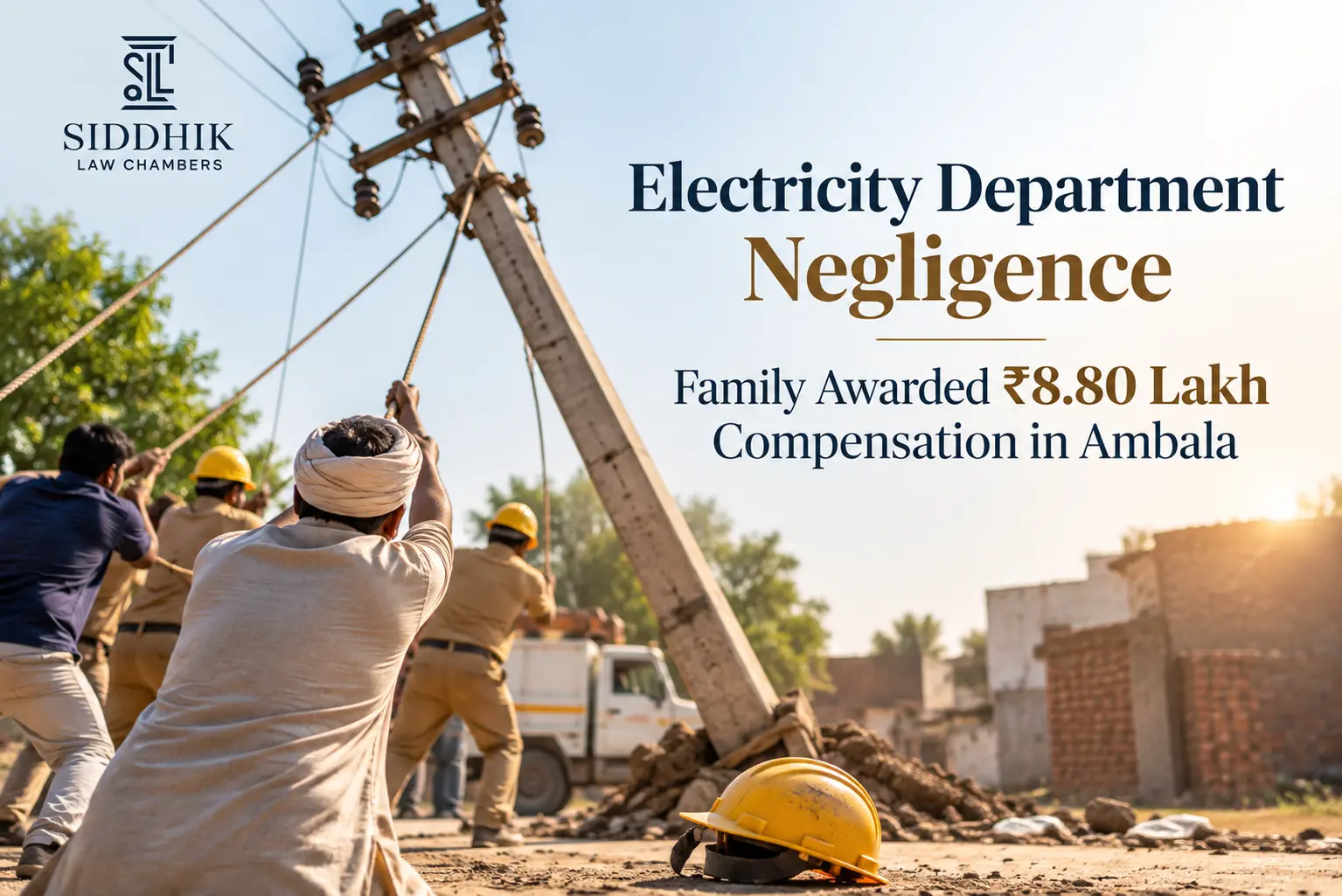
Electricity Department Negligence: Family Awarded ₹8.80 Lakh Compensation in Ambala
A routine electricity department job ended in the loss of a life. The question that followed was simple but important: who should bear responsibility when a member of the public dies while helping electricity department officials carry out their work?
A civil court in Ambala recently dealt with this question in a compensation suit arising from an accident involving the removal of an electricity pole.
The family had initially claimed ₹50 lakh as compensation, alleging negligence on the part of the electricity department. After examining the witnesses, documents and circumstances of the accident, the Court held the department liable and awarded the family ₹8.80 lakh with interest at 6% per annum from the date the suit was filed until realisation.
Advocate Shubham Aggarwal represented the plaintiffs in the proceedings before the Court.
What Happened During the Removal of the Electricity Pole?
The dispute arose from an incident in Ambala in January 2017.According to the plaintiffs, officials of the electricity department had gone to a village to remove an electricity pole. Their case was that local residents were asked to assist the officials and were told that the electricity connection had been disconnected and that it was safe to help.
While the pole was being removed, it fell on the plaintiffs’ father, causing a serious head injury. He was taken to Civil Hospital, Ambala City, where he was declared dead.An FIR was registered on the same day. The post-mortem report recorded the cause of death as extra-dural haemorrhage and shock due to the injuries.
The family subsequently approached the civil court seeking compensation for the loss caused by what they alleged was negligence on the part of the electricity department.
What Did the Electricity Department Say?
The electricity department disputed the family’s version. Its case was that its officials had taken precautions while dismantling the pole and had warned members of the public not to approach the working area.
The department contended that the deceased had come near the pole despite these restrictions. On this basis, it argued that the accident could not be attributed to negligence on the part of its employees.
Sections 101 and 102 of the Indian Evidence Act Became Relevant
An important part of the judgment concerns the burden of proof. The Court specifically reproduced Sections 101 and 102 of the Indian Evidence Act while considering whether the plaintiffs had proved their allegations.
Section 101 deals with the principle that a person asking a court to decide a legal right or liability on the basis of certain facts must prove those facts.Section 102 deals with the question of whom the burden of proof lies upon in a suit or proceeding.
The Court explained that the burden initially rested upon the person asserting the facts and whose case would fail if no evidence were produced. This is an important part of the case because compensation could not be granted merely because an accident had occurred. The plaintiffs still had to establish their case through evidence.
What Evidence Did the Family Produce?
The plaintiffs relied on both oral and documentary evidence. Three witnesses were examined. The documents produced before the Court included the FIR, post-mortem report, death certificate and photograph, along with other supporting records.
The Court found that the evidence established that the deceased had died due to the electrocution/falling of the electricity pole and that there was negligence on the part of the defendants. Once the plaintiffs had established these circumstances, the Court held that the onus shifted to the defendants to establish that there had been no negligence on the part of the department.
One Reliable Witness Can Be Enough
Another useful part of the judgment concerns witness testimony. The defence questioned the evidence produced by the plaintiffs. The Court, however, observed that evidence is not simply a matter of how many witnesses a party produces.
As the judgment explains, it is the quality rather than the quantity of evidence that matters. Even the testimony of a single witness may be sufficient if the Court finds it wholly reliable. In this case, the Court accepted the testimony concerning the circumstances in which the deceased had been helping with the removal of the pole.
Why Was the Electricity Department Held Negligent?
This is perhaps the most important part of the judgment.The department argued that the deceased should not have been near the pole and that the accident could have been avoided had he exercised greater care.
The Court did not accept this defence.It observed that if the deceased was helping the officials, this was within their knowledge. It was the department’s responsibility to ensure that people who should not have been at the work site were kept away and that the work was carried out safely. The Court consequently found negligence and carelessness on the part of the defendants and held them liable to compensate the plaintiffs.
How Was the ₹8.80 Lakh Negligence Compensation Calculated?
The family had sought ₹50 lakh, but the Court did not simply award the amount claimed. Instead, it worked out the compensation using recognised parameters.
The plaintiffs had stated that the deceased earned ₹15,000 per month from factory work. However, the Court found that there was no documentary evidence supporting that income.
It therefore assessed his notional income at: ₹10,000 per month ₹1,20,000 per year. The deceased had left behind four dependants. The Court deducted one-third towards his personal and living expenses, leaving an annual dependency of ₹80,000.The deceased was stated to be 55 years old, and the Court applied a multiplier of 11, referring to the principles discussed in Sarla Verma & Ors. v. Delhi Transport Corporation & Anr. and other authorities.
The calculation therefore became:
₹80,000 × 11 = ₹8,80,000
The Court awarded ₹8.80 lakh along with interest at 6% per annum as Negligence Compensation from the date of institution of the suit until realisation. The defendants were held jointly and severally liable
Why This Judgment Matters
An accident involving an electricity pole or other public utility work can easily be treated simply as an unfortunate incident. This judgment shows why the circumstances surrounding such an accident matter.
The Court examined who controlled the work, whether adequate precautions had been taken, why the deceased was at the site, what the witnesses said, and whether the department had produced sufficient evidence to rebut the family’s case. It also demonstrates that proving negligence and calculating compensation are two separate questions.
Even though the plaintiffs sought ₹50 lakh, the Court independently assessed the available evidence concerning income, dependency and age before arriving at ₹8.80 lakh. For families dealing with an accident involving an electricity department or other public authority, records such as the FIR, medical and post-mortem documents, photographs, witness testimony and official records relating to the incident can therefore become important evidence.
Final Order of the Court
The Court awarded the plaintiffs: ₹8,80,000 as compensation
+ 6% annual interest from filing of the suit until realisation The amount was made payable by the defendants jointly and severally.
The judgment further directed that the decree would be enforceable upon the plaintiffs affixing ad valorem court fee according to the decretal amount within one month from receipt of the certified copy of the judgment. The compensation was directed to be distributed among the plaintiffs in equal shares.
Frequently Asked Questions
Can an electricity department be liable to pay compensation for an accident?
Liability depends upon the facts and evidence in each case. In this matter, the Court found negligence and carelessness on the part of the electricity department and consequently held the defendants liable to compensate the family.
How is compensation calculated in an electricity department negligence case?
There is no single amount applicable to every case. In this judgment, the Court considered notional income, dependency, deduction for personal expenses, the age of the deceased and the applicable multiplier before determining compensation.
What happens if there is no documentary proof of the deceased's income?
The result depends on the evidence and circumstances. Here, ₹15,000 per month was claimed, but the Court found no documentary proof supporting that figure and instead assessed notional income at ₹10,000 per month.
Can compensation carry interest?
Yes, depending on the order passed in the case. Here, the Court awarded 6% interest per annum from the date the suit was instituted until realisation.
Recent Post
-
 Can Police Arrest You Without Prior Notice? Court Directs 5 Days’ Notice Before Arrest
 -
 New Offences Added After Anticipatory Bail — Can Police Arrest You Again?
 -
 Electricity Department Negligence: Family Awarded ₹8.80 Lakh Compensation in Ambala
 -
 Plot Cancelled During a Property Dispute and Sold to Someone Else — What Did the RERA Tribunal Do?
 -
 Parties Reached a Compromise, But What Happens to the FIR?
At Siddhik Law Chambers, civil compensation matters and disputes involving negligence are examined on the basis of the circumstances of the incident, documentary record, evidence available and the legal principles applicable to the particular case.
Need Legal Clarity?
For general information or appointment requests, feel free to contact Siddhik Law Chambers.